BATIK
2025

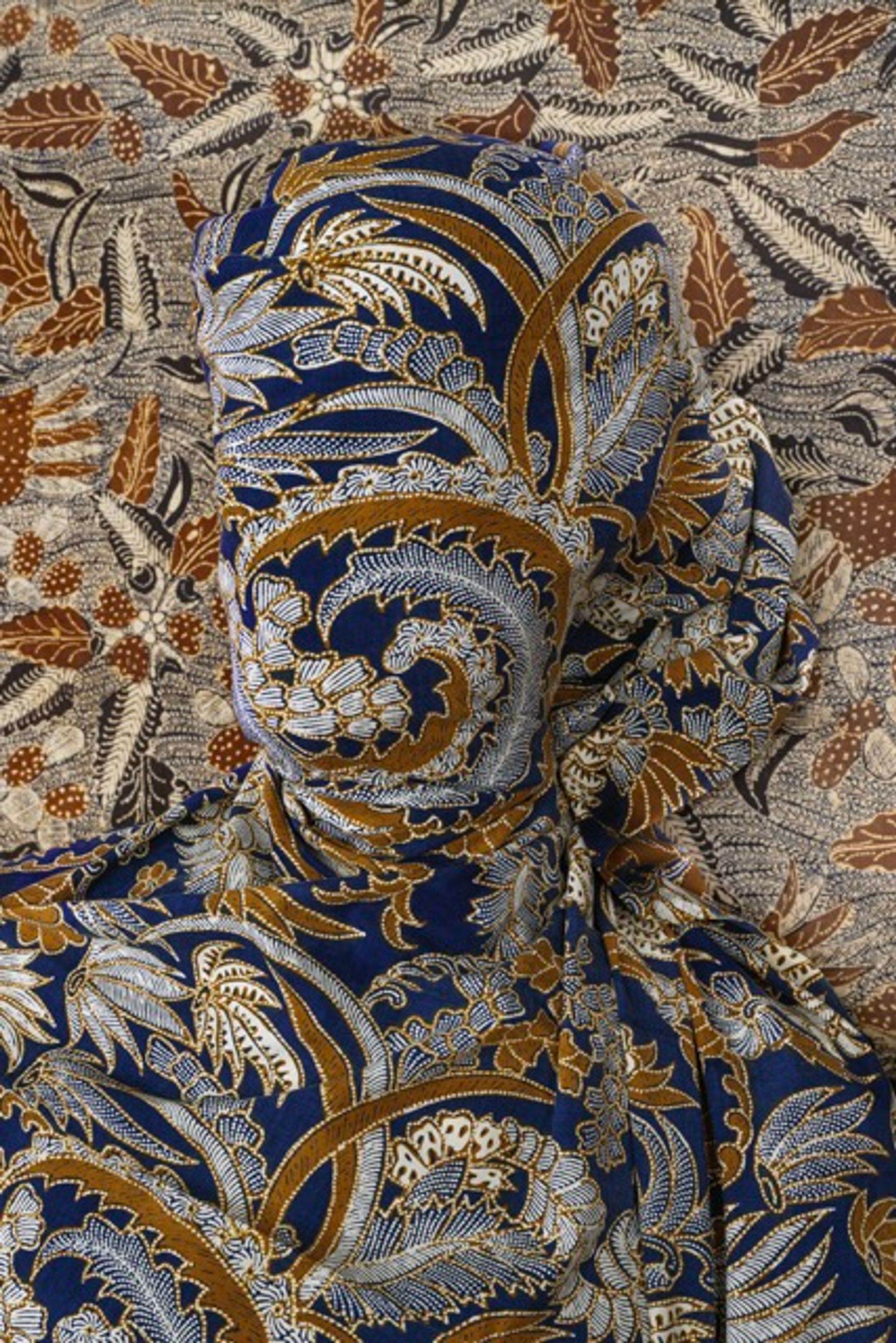
Jamu, 2026
BATIK (2025–26) unfolds through the Indian Ocean, tracing a fabric that has traveled for millennia without losing its name. Rooted in Indonesia and practiced with extraordinary refinement in Java, batik carries within it a history of exchange among cultures that rim the ocean—across Southeast Asia, East Africa, and the Arabian Peninsula, including Yemen. Long before colonial borders, these routes enabled the circulation of objects, materials, and knowledge through shared systems of making.
Yemen is among the world’s oldest cultural landscapes. Cities such as Sana’a and Ma’rib rank among the longest continuously inhabited urban centers, and Yemen’s position along the Red Sea, the Arabian Sea, and the Indian Ocean historically oriented it eastward rather than westward. Through the Indian Ocean network, Yemen was deeply connected to India, Southeast Asia, and the Swahili Coast, sharing not only trade, but also the experience of British colonial domination with regions spanning India, Malaysia, Singapore, Kenya, and Zanzibar.
Before the imposition of colonial classifications and dismissive labels, Southern Arabia—modern-day Yemen—was recognized for its regal status and refinement. That cultural stature did not disappear; it was displaced. While colonial power later privileged the Atlantic and Pacific worlds, the Indian Ocean remains one of the earliest and most sophisticated arenas of global exchange. Long before petroleum, Yemeni seafarers and traders sailing under the banner of Belquis, Queen of Seba’a, circulated materials whose value exceeded modern resource economies: frankincense and myrrh, gold and porcelain, teak and textiles. These exchanges bound distant cultures through shared systems of value, belief, and craft.
The history of these exchanges unfolds alongside the history of batik, a wax-resist textile whose origins move across South and East Asia and whose practice came to be most closely identified with Indonesia. Batik emerges through a process of marking and withholding: wax or other locally sourced resist is applied to cloth before dyeing, allowing color to enter selectively and leave its trace through absence. This sequence is repeated with precision, building layered compositions that require calculation, patience, and embodied knowledge. Whether drawn by hand with a pen or pressed with a carved block, batik inscribes meaning through repetition and care. Its etymology links writing, marking, and tattooing—acts that bind surface to memory through the hand.
My relationship to batik is both personal and collective. As a child, I encountered Indonesian batiks as some of the most vibrant and sophisticated textiles I had ever seen. They carried their identity visibly and unapologetically—never diluted, never absorbed into another place. I later encountered these same batiks in markets in Zanzibar, India, and Singapore, always recognizable as Indonesian, always intact. That continuity stayed with me.
Through time spent in Indonesia, particularly in Java, I developed close collaborations with Javanese batik makers—master artisans who carve copper stamps, artists who practice canting, drawing wax onto cloth by hand, and dyers whose knowledge is held in temperature, timing, and touch. Batik emerges through chant, repetition, and breath. It is carried from land to hand, from hand to hand. It is not merely decorative, but devotional—an embodied form of language.
As the historical archive holds batik’s material legacy, the BATIK series—Dunya (world), Roh (soul), Giwa (mind/spirit), Nafas (breath/self), Kawung (perfection)—forms an archive of cultural exchange among societies connected by shared spiritual and symbolic systems. Batik becomes a language through which value, devotion, and cosmology circulate. Few fabrics so completely embody dunya: the material world in all its beauty, excess, and contradiction.
Batik is also a fabric of resistance. Under Dutch colonial rule, attempts were made to extract, mechanize, and relocate batik production to Europe, severing it from the rhythms of place and community. These efforts failed. Javanese artisans refused separation from their practices, preserving batik as a living system rather than a reproducible commodity. Today, batik remains a marker of resilience and belonging—worn every Friday by state workers, signaling identity through motif, color, and dye, not only across Java but throughout the Indonesian archipelago.
In BATIK, the fabric becomes a witness to circulation rather than conquest. Each cloth holds environment, labor, and belief. Each pattern marks lineage. Like language, batik evolves as it moves, shaped by the land it touches and the hands that carry it forward. Through dreamlike, painterly motifs, BATIK evokes a form of magical realism that exceeds verbal translation, resonating across enduring networks of exchange where knowledge survives through making.