FLOW, IKATIKAT & Their EnvironmentsPhoto Series
2021–202216 Artworks & Installations

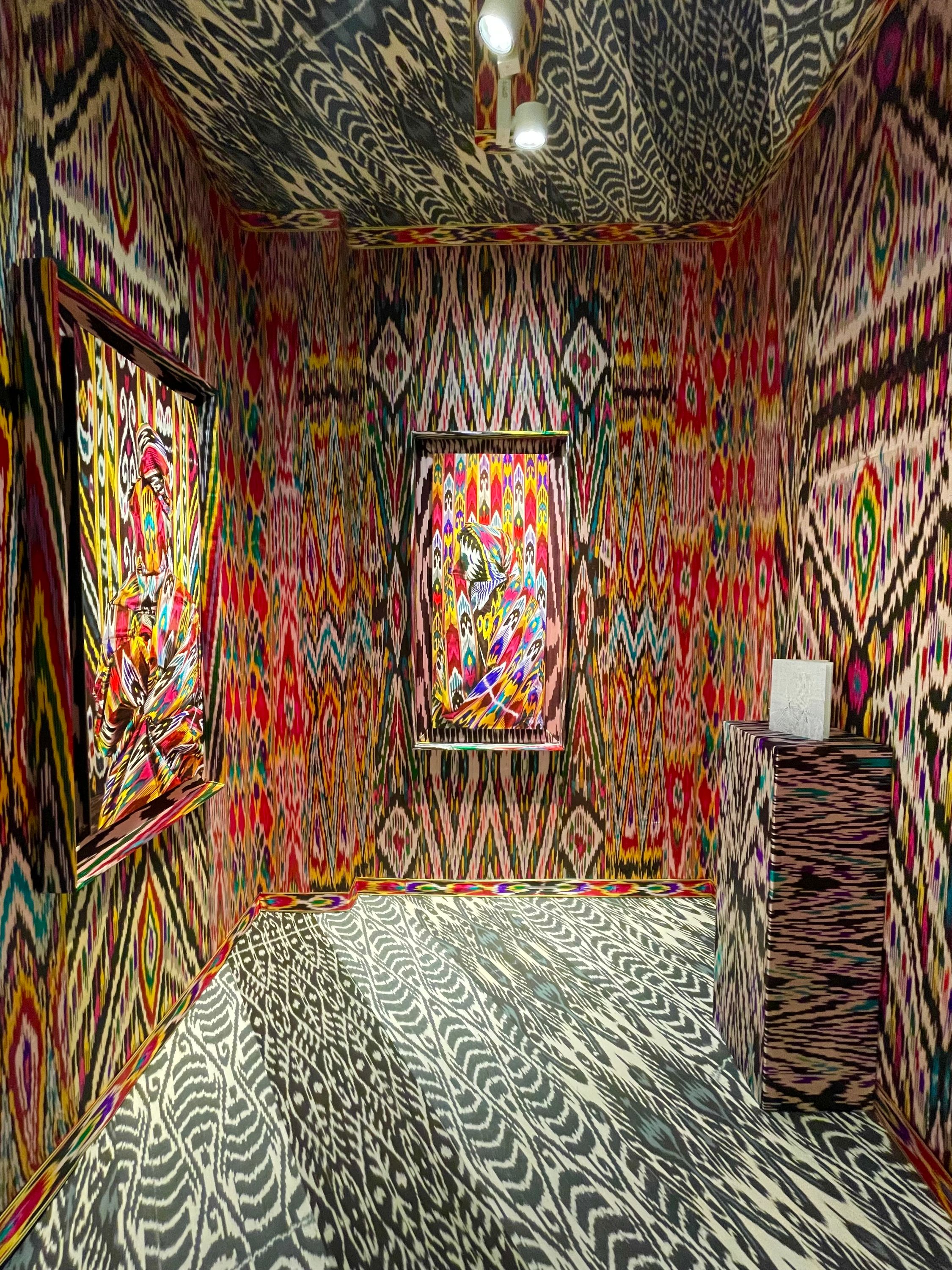
Kaleidoscope Cascades, 2021
FLOW (cotton and silk, 2021)
Ikat takes its name from the Indonesian word meaning “to bind,” yet it is a textile defined by movement. Long before threads are woven together, they are stretched, wrapped, dyed, protected, unbound, and realigned. Pattern exists before surface; image precedes fabric. What appears fluid is in fact rigorously structured, a choreography of resistance and release carried out in advance of touch.
FLOW emerges from this paradox.
Across Islamic, Central Asian, and Southeast Asian cultures, ikat is not simply worn or viewed; it is lived with. In visual traditions where figuration—particularly the human face—has often been absent, pattern assumes narrative weight. Motif becomes memory. The textile carries what portraits do elsewhere: stories, lineages, protections, and blessings. Symbols embedded in ikat—vegetal forms, eyes, pomegranates, horns, rhythmic geometries—are not decorative but active, meant to ward off harm, attract prosperity, and situate the body within a larger cosmology.
These fabrics organize daily life. They shape interiors, absorb sound and light, define thresholds, and orient bodies in space. They hold presence rather than represent it.
Though often discussed as a single cloth, ikat is a global practice with deeply localized meanings. Known as endek in Indonesia, kasuri in Japan, atlas among Uyghurs, tiraz in Yemen, patola in Gujarat, and by many other names, it carries distinct cultural functions while maintaining a shared resist-dye process in which threads are colored before they are woven. Historically regarded as one of the “holy weaves,” ikat was reserved for ceremony, protection, and power. Its efficacy lies not in material luxury alone, but in the accumulation of labor, symbol, and time.
My earliest encounters with ikat were not academic. As a child traveling with my mother, I encountered it in markets, across bodies, within interiors. I remember the way it moved, how patterns vibrated as garments flowed, how the eye resisted stillness. Years later, I learned that Yemen, my native land, had once been renowned for tiraz ikat, produced in cotton and silk and often embellished with gold leaf, circulating across the Islamic world as garments of honor, devotion, and inscription. These textiles were also historical documents, registering shifts in power, exchange, and belief through pattern rather than image.
Within ikat, symbols do not remain fixed. Over time they transform, reflecting moments of conflict and change: vegetal motifs reappear altered, landscapes compress, references to war surface obliquely. The cloth becomes an archive—not static, but responsive—recording history through vibration rather than depiction.
FLOW attends to this intelligence. The photographic sculptural works emphasize oscillation, the way pattern destabilizes fixed perception, how movement interferes with categorization. What seems to ripple does so because it must. The textile breathes.